ESG Strategy for CEOs: Beyond Compliance to Competitive Advantage
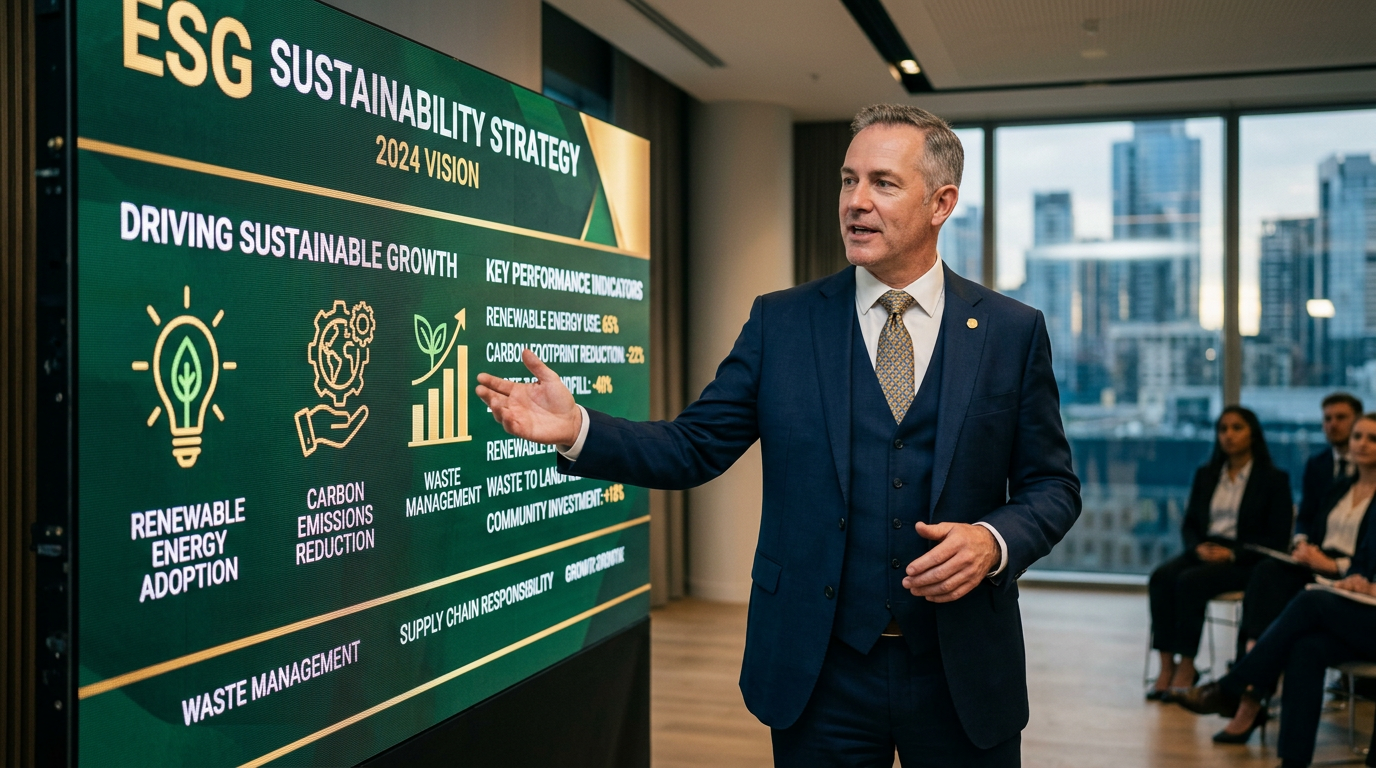
ESG strategy has moved beyond a voluntary labeling exercise. Tightening reporting expectations, investor scrutiny, and the growing role of CFOs and general counsels have made sustainability information part of the corporate control environment.
Compliance is necessary, but it is not a complete strategy. An organization can produce more disclosures without improving operations, reducing risk, or strengthening its competitive position. Conversely, digital investment framed as sustainable can generate hidden resource costs or contribute to “ESG decoupling,” where public claims and operational reality diverge.
The CEO’s task is to connect material environmental, social, and governance issues to the business model—and then measure the connection with the rigor used for financial decisions.
Start With Business Materiality
An effective ESG strategy does not attempt to optimize every possible metric. It identifies the sustainability issues most capable of affecting the organization’s operations, cash flows, risk exposure, stakeholder relationships, and strategic options.
A CEO-led materiality process should answer:
- Which ESG issues can alter operating performance?
- Which create legal, reporting, or reputational exposure?
- Which depend on supplier or customer behavior?
- Which require capital investment?
- Which can influence innovation or market positioning?
- Which disclosures must be supported by assurance-ready data?
The resulting priorities should be few enough to govern. A long list of ambitions without owners, investment choices, or controls is not a strategy.
As companies prepare for evolving reporting obligations, materiality is becoming more central. The focus should shift from collecting every available data point to governing the information most relevant to the business and its stakeholders.
Integrate ESG Into the Operating Model
ESG should not operate as a parallel reporting function. It belongs in existing management processes:
- Strategy development
- Enterprise risk management
- Capital allocation
- Procurement
- Product and innovation decisions
- Digital transformation
- Performance management
- External reporting
Each material priority needs an executive owner and an operational owner. The executive owner is accountable for the business outcome. The operational owner is accountable for data, execution, and controls.
The CFO should establish the measurement architecture. The general counsel should assess disclosure and legal exposure. Operations and procurement should own changes in processes and supply-chain behavior. The board should oversee material risks and commitments.
This structure prevents the sustainability team from becoming responsible for results it cannot operationally control.
Build a Value-and-Risk Thesis
For each material ESG priority, management should define how value could be created or protected.
A practical thesis has four components:
- Operational value: Efficiency, resource visibility, or process improvement.
- Risk protection: Regulatory, litigation, supply-chain, or reputational exposure.
- Strategic option: Innovation, differentiation, or access to future opportunities.
- Reporting requirement: Data and controls needed for credible disclosure.
The thesis should distinguish between evidence and aspiration. Research associates strong combined performance in growth, profit, and ESG with higher growth, but association does not prove that an ESG initiative will produce a specific financial outcome.
Executives should therefore build business cases from company-specific baselines rather than external performance claims.
Use Digital Transformation as Infrastructure
Digital tools can improve the tracking of energy use, emissions, pollutants, and supply-chain compliance. Cloud platforms, connected devices, and analytics can replace manual spreadsheet reporting with more frequent and controlled information.
The digital architecture should connect:
- Source operational systems
- Defined ESG metrics
- Ownership and approval workflows
- Data-quality checks
- Reporting taxonomies
- Disclosure and assurance processes
The IFRS Sustainability Disclosure Taxonomy 2024 supports digital tagging of sustainability-related financial disclosures. More than 1,000 companies had referenced ISSB in their reports by late 2024, while 35 jurisdictions were making progress toward adoption. This movement increases the importance of scalable and interoperable reporting systems.
ISSB Standards build on frameworks including TCFD and SASB, while collaboration with EFRAG and GRI seeks to improve interoperability. CEOs should monitor applicable jurisdictional requirements rather than assume one framework resolves every reporting obligation.
Control the ESG Data Chain
More than half of executives in the research cited poor data quality as a primary challenge. That problem becomes acute when ESG information originates in operating sites, suppliers, spreadsheets, and systems with inconsistent definitions.
A controlled data chain should document:
- Metric definition
- Source system
- Collection frequency
- Calculation methodology
- Accountable owner
- Review and approval
- Change history
- Disclosure destination
- Assurance status
Every material claim should be traceable to evidence. Where estimates are necessary, methodology and uncertainty should be disclosed internally and handled consistently.
This is not merely a reporting concern. Weak data can cause management to allocate capital based on an incorrect understanding of operating performance.
Measure Performance With a Balanced Scorecard
An ESG dashboard should connect outcomes, economics, and control quality.
Outcome metrics
- Performance against the organization’s material environmental or social objectives
- Supplier compliance with defined requirements
- Progress on governance commitments
Economic metrics
- Capital invested
- Operating cost changes
- Avoided or mitigated exposure
- Revenue or innovation initiatives linked to the strategy
- Variance from the approved business case
Control metrics
- Data completeness
- Number of manual adjustments
- Unresolved data-quality issues
- Percentage of material metrics with documented ownership
- Assurance readiness
- Disclosure corrections or exceptions
The specific measures must reflect the organization’s material issues. The scorecard should not imply that all ESG outcomes can be converted into one financial number.
Account for the Rebound Effect
Digitalization can improve monitoring and efficiency, but some research warns of a rebound effect: the resources required to operate complex digital systems may offset part of the intended environmental benefit.
The CEO should require digital ESG programs to account for their own operating footprint and hidden costs. Before approving a platform or data-intensive process, management should ask:
- What resources are required to run it?
- Which manual systems will actually be retired?
- Does greater measurement produce better decisions?
- Could a simpler architecture provide sufficient control?
- How will the net effect be evaluated?
This discipline prevents technology adoption from being mistaken for sustainability performance.
Apply Stage Gates to ESG Investment
A disciplined process includes four gates.
Gate 1 — Materiality: Is the issue strategically or financially relevant?
Gate 2 — Evidence: Is the baseline credible enough to support a decision?
Gate 3 — Economics and risk: Are expected benefits, costs, uncertainty, and risk reduction explicit?
Gate 4 — Disclosure integrity: Can external claims be supported by controlled information?
Initiatives that pass the first three gates but fail the fourth may still have operating value, but management should avoid overstating them publicly.
Put ESG on the Executive Cadence
Monthly operating reviews should address performance exceptions and data quality. Quarterly executive reviews should evaluate investment, risk, and delivery against the business case. Board reviews should focus on material commitments, major exposure, disclosure integrity, and unresolved management judgments.
The CEO should insist that the same story appears in operations, finance, risk reporting, and external communications. Inconsistency is a signal that ESG remains disconnected from the business.
Competitive advantage does not come from attaching an ESG label to existing activity. It comes from identifying material issues earlier, using better information, governing commitments more rigorously, and converting selected priorities into operating capability. Compliance sets the floor. Strategic integration determines whether the organization creates value above it.